

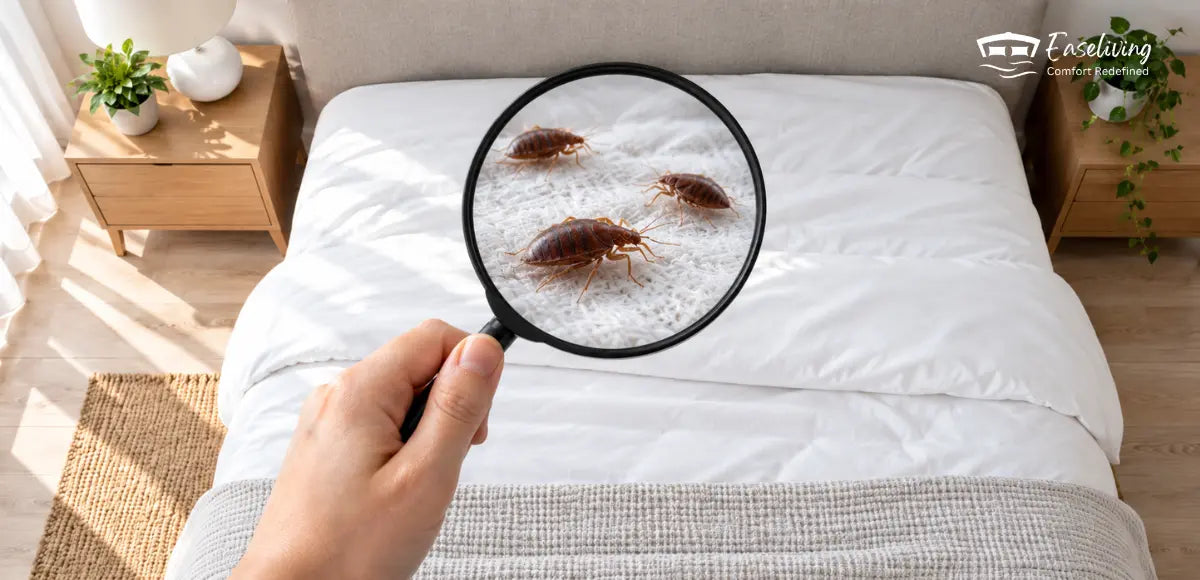
The most reliable way to deal with dust mites in a mattress is to combine four habits: wash your bedding every week in water of at least 54°C (130°F), seal the mattress in a tightly woven cover, keep bedroom humidity below 50%, and clear the dust that builds up around the bed. No single step removes every mite. Together, though, they cut down both the mites and the allergens they leave behind, and the allergens are what actually affect how you breathe and sleep.
Below you will find how to spot a problem, a routine that suits UAE homes, and where mattress material fits in.
What Are Dust Mites and Why Do They Live in Your Bed?
Dust mites are microscopic, eight-legged relatives of spiders. According to the Cleveland Clinic, they settle into bedding, mattresses, carpets, curtains and other fabric surfaces. You cannot see them or feel them. What they need is simple: warmth, a little moisture, and food, which inside a home mostly means the dead skin cells we shed every night.
That is why dust mites in bed are so common. A mattress offers all three, night after night, for years. The Cleveland Clinic also notes that mites reproduce in humid conditions, so a damp or poorly ventilated bedroom makes dust mites in bed even harder to manage.
Source: Cleveland Clinic
Are dust mites actually harmful?
For many people, no. Mites do not bite or spread disease. The trouble starts when the immune system reacts to proteins in their droppings and body fragments. That reaction is a dust mite allergy, and it can show up as sneezing, a blocked nose, itchy eyes, coughing or wheezing. For people with asthma, mite allergens are also a recognised trigger, according to the Minnesota Department of Health.
Source: Minnesota Department of Health
Dust Mite Allergy Symptoms at Night: Is Your Mattress the Problem?
Dust mite allergy symptoms at night are easy to mistake for a cold, and a dust mite allergy mattress problem rarely announces itself. You go to bed feeling fine, spend the night with a stuffy nose or a tickle in the throat, and wake up with itchy, watery eyes. A few clues point towards the bed rather than a virus:
- Symptoms are worst in the bedroom or first thing in the morning, and ease once you have been out of the house for a while.
- There is no fever or body ache, and the symptoms keep returning for weeks.
- You notice wheezing or chest tightness at night, especially if you already have asthma.
If your symptoms ease when you sleep elsewhere, dust mites in bed are a likely suspect. It is advised to speak to a healthcare provider if you suspect a dust mite allergy, as they may suggest allergy testing to confirm it. A proper diagnosis matters, because pollen, pet dander and mould can cause very similar symptoms.
How to Get Rid of Dust Mites in a Mattress: A Step-by-Step Routine
Here is the routine the Mayo Clinic and other health bodies keep coming back to. If you have ever searched for how to get rid of dust mites in mattress layers without replacing the whole thing, this is the answer.
Step 1: Wash all bedding weekly in hot water
The Mayo Clinic recommends washing sheets, blankets, pillowcases and bedcovers every week in water that is at least 54.4°C (130°F), which kills dust mites and removes allergens. If an item cannot take that heat, Mayo suggests running it through the dryer for at least 15 minutes above 130°F, then washing and drying it as usual. Check care labels first, because not every fabric tolerates high temperatures. Soft toys that live on the bed deserve the same treatment, and it is advised keeping them off the bed altogether.
Step 2: Vacuum the mattress, but do not rely on it
Go over the whole surface, including seams and edges, ideally with a HEPA-filter vacuum. Be realistic about what this achieves, though. The Mayo Clinic points out that vacuuming removes surface dust but is not effective at removing most dust mites and their allergens. Treat it as housekeeping that supports the other steps.
Step 3: Seal the mattress with a dust mite proof mattress cover
If you only add one thing to your routine, make it this one. The Mayo Clinic advises keeping mattresses and pillows in dustproof or allergen-blocking covers made of tightly woven fabric, which stop mites from colonising the mattress and from escaping out of it. A mattress encasement for dust mites wraps the entire mattress and closes with a zip.
Source: Mayo Clinic
Alongside an encasement, a washable mattress cover that fits like a fitted sheet gives you a layer you can launder regularly. Easeliving's Waterproof Bamboo Mattress Protector is made from natural bamboo fabric that is naturally resistant to dust mites, allergens and bacteria, and it is machine washable. It also carries a waterproof barrier against sweat and spills, and its 360° elastic skirt fits mattresses up to 35 cm deep. For anyone looking for a mattress protector for allergies that does not feel like plastic, it is a practical place to start.
Step 4: Keep humidity under 50%
Mites take in water from the air rather than drinking it, so dry air works against them. It is recommended keeping indoor relative humidity below 50 percent, using a dehumidifier or air conditioner, and checking the level with a hygrometer. In the UAE, air conditioning does much of this work for you. Still, rooms that are shut up all day in summer, bedrooms next to bathrooms and some coastal homes can run damp.
Step 5: Cut down the clutter around the bed
Mites do not stay in the mattress, which is why wondering how to get rid of dust mites in mattress layers also means looking at the room around it. Heavy curtains, carpets and piles of cushions all hold dust, and Mayo's advice is blunt: if something collects dust, it also collects dust mites. Damp-dust bedroom surfaces weekly, and remember that even a brand-new mattress is not a clean slate. Without a cover, it starts hosting mites from the first night.
Does the Type of Mattress and Pillow Matter for Dust Mite Allergy?
Yes, to a certain extent. No mattress or pillow is completely dust mite proof, because mites can live on the surface of any bed. Regular washing and protective covers matter whatever you sleep on. What the material changes is how easily mites, moisture and dust settle in, which is why anyone shopping for a hypoallergenic mattress UAE brands offer, starts by comparing materials.
How Mattress Materials Differ
Natural organic latex has a dense, open-cell structure that lets air circulate, which gives mites less to settle into than loose fibre fillings. Dense foams like memory foam also leave little room for dust to work inside. Easeliving's 7-Zone Natural Organic Latex Mattress Collection offers a responsive, breathable latex surface, while the Cool Gel Memory Foam Mattress Collection suits those who prefer a body-contouring feel.
Why Your Pillow Matters Too
Your pillow sits closest to your nose and mouth, so dustproof covers for pillows as well as mattresses are advised. It should also be easy to wash. The Hypoallergenic Sanitized Pillow has an antibacterial, hypoallergenic construction, is OEKO-TEX certified and is machine washable.
A Simple Routine You Can Actually Keep
Consistency beats intensity here. Most households can manage this schedule:
- Every week: Wash bedding at 54°C or above where fabrics allow, damp-dust the bedroom, and vacuum the mattress surface.
- Every month: Check your hygrometer, launder the washable mattress cover or protector according to its care label, and vacuum around the bed frame.
- Every 7-10 years: Replace the mattress, or sooner if it sags or symptoms keep worsening despite good cleaning.
FAQs About How to Get Rid of Dust Mites in a Mattress
Can you completely get rid of dust mites in a mattress?
Not completely, and nobody can honestly promise that. What you can do is bring the numbers down and keep them low with weekly hot washes, a proper cover, controlled humidity and regular dusting.
Does a dust mite proof mattress cover really work?
Health bodies including the Mayo Clinic recommend them as a core step, because tightly woven covers stop mites from colonising the mattress. A full mattress encasement for dust mites works best, with a mattress protector like Easeliving's Waterproof Bamboo Mattress Protector for allergies and regular bedding washes on top.
Is a 7-zone natural organic latex mattress better than memory foam for dust mite allergy?
A 7-Zone Natural Organic Latex Mattress can be a good option for people concerned about dust mite allergies because organic latex is breathable and does not retain moisture as easily as some traditional foam materials. Using a washable mattress protector, regularly cleaning bedding, and controlling bedroom humidity are still important for reducing dust mite exposure.
Where is the best place to buy a mattress for dust mite allergies in the UAE?
Directly from the manufacturer, where you get full product information, custom sizing and someone who knows the mattress well. Easeliving mattresses are made in the UAE and come with free delivery and installation within 1 to 3 days, a 15-day trial and up to a 10-year warranty.
Sleep Cleaner, Breathe Easier
Dust mites will never leave your home entirely, but they do not have to ruin your nights. A weekly hot wash, a well-fitted washable mattress cover, a full mattress encasement for dust mites, drier air and a less cluttered bedroom do most of the work, and the right mattress makes it easier to keep up. Whether you start with a mattress protector for allergies, a dust mite proof mattress cover or a new dust mite allergy mattress, the habits matter most when tackling dust mites in mattress layers.
Easeliving is one of the trusted brands listed among the best sellers on e-commerce platforms such as Amazon and noon, and you can also buy directly from the Easeliving website, where you will find the full range, custom sizing, free delivery and a 15-day trial. Browse the collection below, or get in touch if you would like a recommendation.


